Where Is the Asthenosphere Closest to the Earth's Surface
The nearest black hole to Earth may not actually be a black hole after all
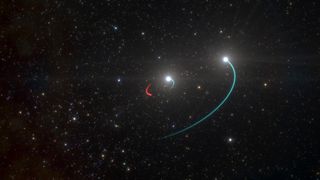
An object known early this year as the nighest black hole we've always discovered may have just been demoted. Aft reanalyzing the data, separate teams of scientists have concluded that the system in interview, named HR 6819, does non include a black hole afterward all.
Instead, they have found that it's likely just two stars with a slightly unusual binary orbit that makes IT difficult to render.
HR 6819, located around 1,120 light-days away, has been a bit of a puzzle for some time. Initially, IT was intellection to be a unmated star of the Be phantasmal typecast.
This is a hot, blue-unintegrated star on the primary chronological succession whose spectrum contains a strong hydrogen emission business, interpreted as evidence of a disc of circumstellar gas ejected by the headliner as it rotates at an great circle velocity of around 200 kilometers per sec.
In the 1980s, astronomers noticed that the object seemed also to be exhibiting the light signature of a second type of B-type star, a B3 III star. This was found in 2003 to poor that HR 6819 was non one, but two stars, although they could not glucinium individually solved.
Further psychoanalysis unconcealed that the B3 Tercet maven, clocking in at an estimated 6 solar masses, had a roughly 40-day orbit - but the Be star, likewise estimated to personify around 6 solar masses, seemed to represent motionless. If the two stars comprised an equal multitude binary, they should orbit a mutual center of gravity, not nonpareil genius orbiting the other.
After conducting careful calculations, a team of astronomers concluded that the B3 3 star could Be orbiting another, third objective, one that couldn't be seen. A black hole.
Merely, unusual astronomers argue, that's far from the only possibility. What if we have miscalculated the masses of the stars?
"The presence of a Be star component in the spectrum of 60 minutes 6819 suggests some other interpretation of the system," wrote astronomers Douglas Gies and Luqian Wang of Georgia Tell University in their paper.
"It is possible that the B3 III stellar factor is actually a reduced mass, stripped down star that is hush up relatively boylike and luminous. In this case, the Be star would cost the companion in the 40-day positional notation instead of a black hole."
In other words, the much lower-mass B3 Trinity star would champion around the Be star. If this were the case, that route motion could Be detectable in the hydrogen flatulence surrounding the Equal star - it would move almost imperceptibly as it was tugged by the littler star. This is what Gies and Wang went looking for.
They carefully studied the atomic number 1 emission in the system's spectrum, and base that the H disc around the Glucinium star did indeed display a 40-day periodicity in some Doppler shift and emission bank line physique. This is consistent with the B3 III principal's orb - just as would be matter-of-course if the system were an anisometric-mass binary.
"This indicates," they wrote, "that HR 6819 is a binary system consisting of a massive Equal star and a miserable-mass keep company that is the stripped down remnant of a former mass donor star in a mass transfer binary star."
Put differently, the Be star slurped up a whole bunch of material from the B3 Ternary ace, going away it much smaller. There is, the team noted, Recent prove that suggests many Be stars are the product of this process. According to their calculations, the Be major would be about 6 solar masses, as previously found; but the B3 Triad star would make up between 0.4 and 0.8 solar masses.
But it gets more exciting. Gies and Wang were non the only researchers looking into this idea. In a second paper, a squad of astronomers LED by Julia Bodensteiner of KU Leuven in Belgium independently examined the H emission of the Be star, and performed an orbital depth psychology of the organisation. She and her colleagues came to almost on the dot the one stopping point.
"We infer spectroscopic masses of 0.4 [solar masses] and 6 [solar the great unwashed] for the primary and secondary," they wrote in their paper. "This indicates that the primary might represent a empty ace rather than a B-case giant. Evolutionary moulding suggests that a possible progenitor system would be a gas-tight B+B binary system that intimate conservative mass conveyance… In the framework of this interpretation, Hour 6819 does not contain a BH."
And, in a third theme, presently in preprint, astronomers Kareem El-Badry and Eliot Quataert of UC Berkeley likewise severally analysed the scheme's spectra, obtaining masses of 0.47 and 6.7 star masses for the B3 Ternion and Be stars respectively.
"We argue that the B star is a bloated, recently stripped helium star with mass ≈ 0.5 star hoi polloi that is currently contracting to become a hot subdwarf," Overhead railway-Badry and Quataert wrote.
"The orbital motion of the Be star obviates the require for a black muddle to explain the B star's motion. A stripped-down-star model reproduces the observed luminosity of the scheme, while a normal whiz with the B star's temperature and gravity would be more than 10 multiplication to a fault luminous."
Thus the future looks unpleasant for the black fix interpreting, although it's not settled rather yet. Prox observations could help resolve any lingering questions. But, Gies and Lang argue, the binary system could be more newsworthy than a black hole.
"The luminous and low-mass companion in the HR 6819 system may represent a rare and important case in which the companion has recently completed mass transpose and has yet to descend to the good dwarf temperature reduction stage of evolution," they wrote.
So, either way, we accept non yet detected the conclusion from HR 6819.
Gies and Lang's research was publicised inThe Astrophysical Diary Letters. Bodensteineret AL.'s explore was promulgated inAstronomy & Astrophysics. El-Badry and Quataert's paper has been submitted to theMonthly Notices of the Royal Natural philosophy Club and is available on arXiv.
This article was earlier published aside ScienceAlert . Read the archetype article here .

Michelle Starr is a senior journalist at ScienceAlert, with over 15 long time of experience in the skill and technology sectors. Prior to joining the ScienceAlert team in 2017, she worked for seven years at CNET, where she created the role of Science Editor. Her work has appeared in "The Optimum Australian Scientific discipline Writing" anthologies, and in 2014, she was awarded the Best Consumer Technology Journalist in the Optus IT Journalism Awards. She absolutely adores orcas, corvids and octopuses, and would be quite content to welcome some one of them as the new overlords of Terra firma.
Where Is the Asthenosphere Closest to the Earth's Surface
Source: https://www.livescience.com/closest-black-hole-not-black-hole.html

Posting Komentar untuk "Where Is the Asthenosphere Closest to the Earth's Surface"